Why cost per mile matters
Brokers quote rates per mile, so you need to compare like with like. If you don't know your own cost per mile, you can't tell a good load from a bad one. Many owner-operators find out only at tax time that some lanes never paid.
The fastest way to get your number is the trucking cost per mile calculator. The steps below show what goes into it, so you can gather the right figures.
Step 1: List your fixed costs
Fixed costs stay the same whether the truck runs 6,000 or 12,000 miles in a month. Add up a normal month of:
- Truck and trailer payments (or lease payments)
- Insurance: primary liability, cargo, physical damage and bobtail or non-trucking liability
- Permits and registration: IRP plates, UCR, Form 2290 heavy vehicle use tax, IFTA decals (divide yearly costs by 12)
- ELD subscription, phone, load board and accounting software
- Parking, and fees for a bookkeeper or accountant
- Your own pay. Put in a fixed salary for yourself. If the truck can't pay you, it isn't profitable, whatever the bank balance says.
Step 2: List your variable (per-mile) costs
Variable costs rise with every mile you drive:
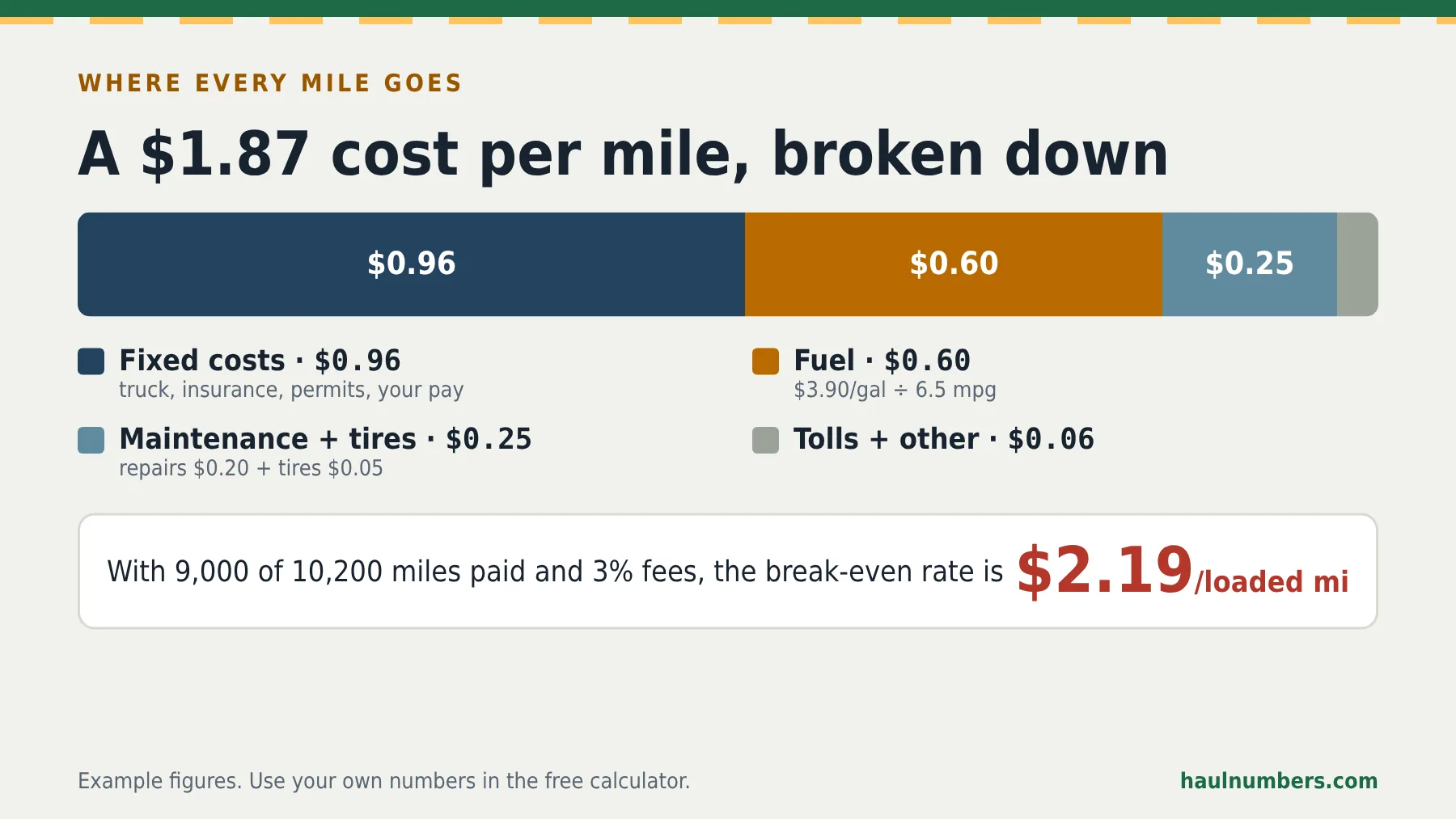
- Fuel: diesel price divided by your real MPG. At $3.90 a gallon and 6.5 mpg, fuel is $0.60 a mile. The fuel cost calculator includes idling and DEF.
- Maintenance and repairs: track a full year of invoices and divide by the miles. Older trucks need a bigger number.
- Tires: the cost of a full set divided by the miles you expect from them.
- Tolls and scale fees, averaged per mile.
Step 3: Count every mile, not just paid miles
Add loaded miles and empty (deadhead) miles from your ELD or trip sheets. Fixed costs are spread over all miles, because the truck costs the same whether a trailer is loaded or not.
Cost per mile = (monthly fixed costs ÷ total miles) + variable cost per mile
Step 4: Turn it into a break-even rate
You are only paid on loaded miles, and factoring or dispatch fees come off the top. So the rate you need per loaded mile is higher than your raw cost per mile:
Break-even rate = total monthly cost ÷ loaded miles ÷ (1 − fee %)
Example: $19,082 of monthly costs, 9,000 loaded miles and 3% fees gives a break-even of about $2.19 per loaded mile. Any load paying less loses money once you count deadhead and your own pay.
Step 5: Compare it with the industry
The American Transportation Research Institute (ATRI) puts the average fleet's 2025 marginal cost at $2.336 per mile, including driver wages and benefits. Large fleets buy fuel, tires and insurance more cheaply, so a small operation is often higher. If you are far above the average, start with fuel economy, deadhead and insurance.
Keep it current
Recalculate every month, and whenever diesel moves more than about 20 cents or your insurance renews. HaulNumbers saves your result on your device and fills it in automatically on the load profit calculator and the deadhead calculator.
Common questions
Should I include my salary in cost per mile?
Yes. Treat your pay as a fixed cost so the break-even rate covers you, not just the truck.
Do deadhead miles count in cost per mile?
Yes. Divide fixed costs by all miles driven, loaded and empty, to get a true cost per mile.