Self-employment tax
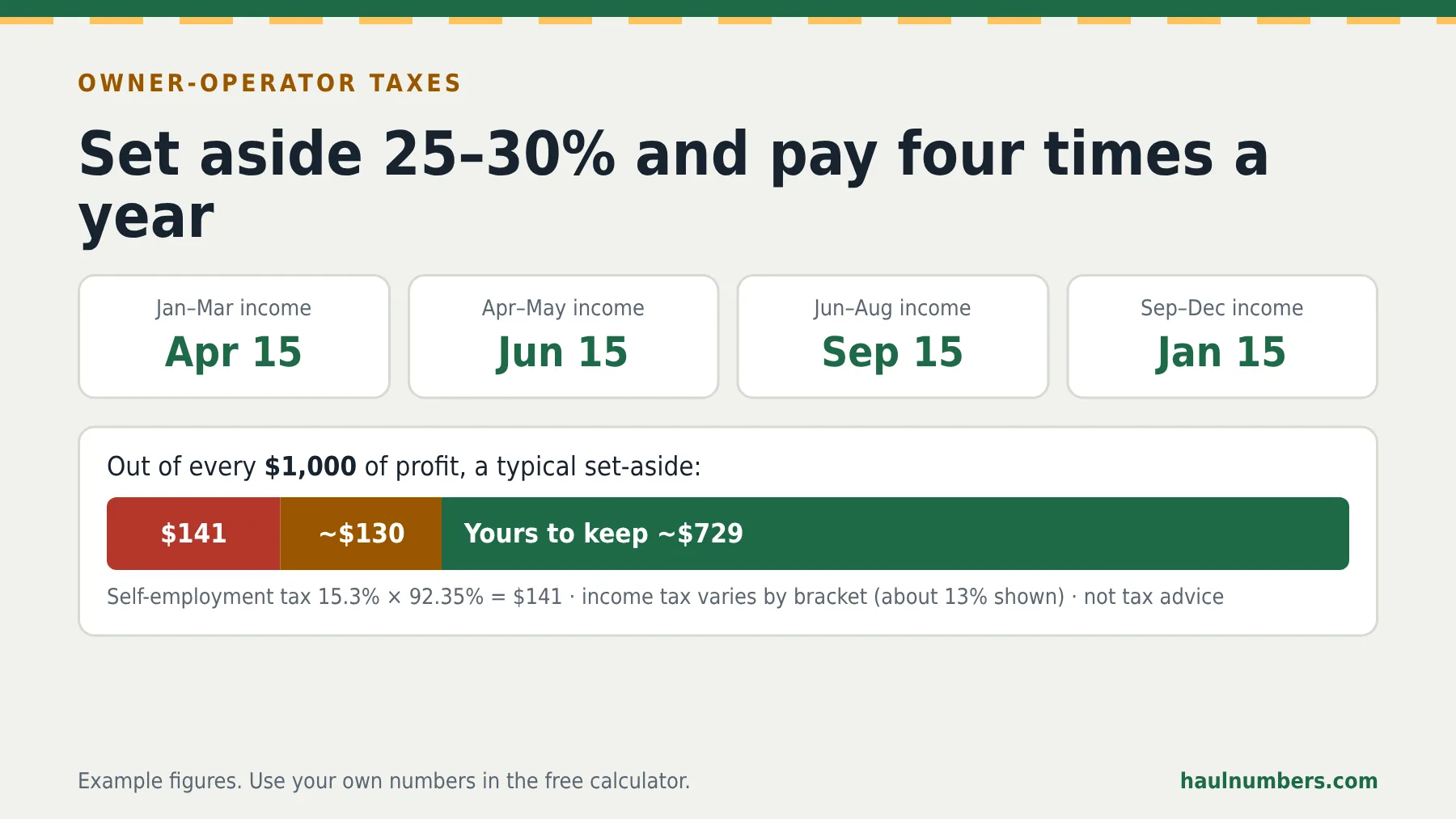
Self-employed drivers pay both halves of Social Security and Medicare: 15.3% on 92.35% of net profit, on top of income tax. You can deduct half of it when working out income tax. The owner-operator income calculator estimates both.
Quarterly estimated payments
No employer withholds tax for you, so the IRS expects payments during the year if you'll owe $1,000 or more. Federal due dates:
| Income earned | Payment due |
|---|---|
| Jan 1 – Mar 31 | April 15 |
| Apr 1 – May 31 | June 15 |
| Jun 1 – Aug 31 | September 15 |
| Sep 1 – Dec 31 | January 15 (next year) |
A simple habit: move 25–30% of each settlement's profit into a separate tax account.
Common deductions
- Fuel, maintenance, repairs and tires
- Truck depreciation or lease payments, and loan interest
- Insurance premiums
- Per diem for meals: 80% of $80 a day in 2026. See the per diem guide.
- ELD, phone, load boards, software and accounting fees
- Permits, IRP, IFTA, UCR and Form 2290 heavy vehicle use tax
- Tolls, scales, parking and truck washes
Records
Keep every receipt and settlement statement, and use a separate business bank account. Good records make IFTA, per diem and audits much easier.
Get help
A tax professional who works with truckers usually pays for themselves. Use HaulNumbers to estimate, then confirm with a pro.
General information, not tax advice. Rules change, so check current IRS guidance.
Common questions
How much should an owner-operator save for taxes?
Many set aside 25–30% of net profit to cover self-employment and income tax.
When are quarterly taxes due?
April 15, June 15, September 15 and January 15.